Based at Universidade Nova de Lisboa, the project LITESCAPE.PT – Atlas das Paisagens Literárias de Portugal Continental is run by IELT – Instituto de Estudos de Literatura e Tradição (FCSH), in partnership with IHC – Instituto de História Contemporânea (FCSH), Fabula Urbis and the Fundação Eça de Queiroz. Directed by the biologist Ana Isabel Queiroz between 2010 and 2017, the project led to the creation of an app and has been coordinated by Daniel Alves and Natália Constâncio since 2018.
In 2025, these two researchers took part in one of the Conversations on Literary Tourism held at the Lisboa Pessoa Hotel, under the theme Portugal: Literature and (is) Landscape. In this interview-style article, we revisit their words as they outline the key features of the “Atlas das Paisagens Literárias de Portugal Continental” itself.
1. What are the main guiding principles of the Atlas das Paisagens Literárias de Portugal Continental?
D.A./N.C.: We wanted to study patterns in landscape change, using literature as our primary source. It is a project that seeks to contribute to a certain degree of environmental literacy, as well as to tourism. It comprises a set not only of information, but also of tools designed to support precisely that.
The project has three strands. It is a collaborative project, in that it draws on the contribution of 54 readers who currently have data in the database and who come from a wide range of disciplinary backgrounds. Hence the second component: it is an interdisciplinary project, bringing together people from literature, anthropology, biology, history and many other fields of knowledge. It is also a project with a strong digital dimension, not only in terms of research and research methodology, but also in terms of dissemination, since we have the website.

2. What does the project fundamentally involve?
D.A./N.C.: The aim was to study landscape through literature produced after Romanticism, since the very idea of reading landscape during the Romantic period was different. What we wanted to do was use all the literature, from the mid-nineteenth century to the present day that refers to mainland Portugal, and extract from it descriptions of landscapes. Not every description of landscape, but at least those in which it was possible to identify territorial units, for statistical purposes and for the organisation of territory.
These territorial units have nothing to do with literature itself, but they make it possible to carry out a statistical analysis of the number of references appearing in each area of the country, and thus to identify the fauna, flora and landscapes associated with them.

3. What can users do through the project’s online platform, particularly in the context of literary tourism?
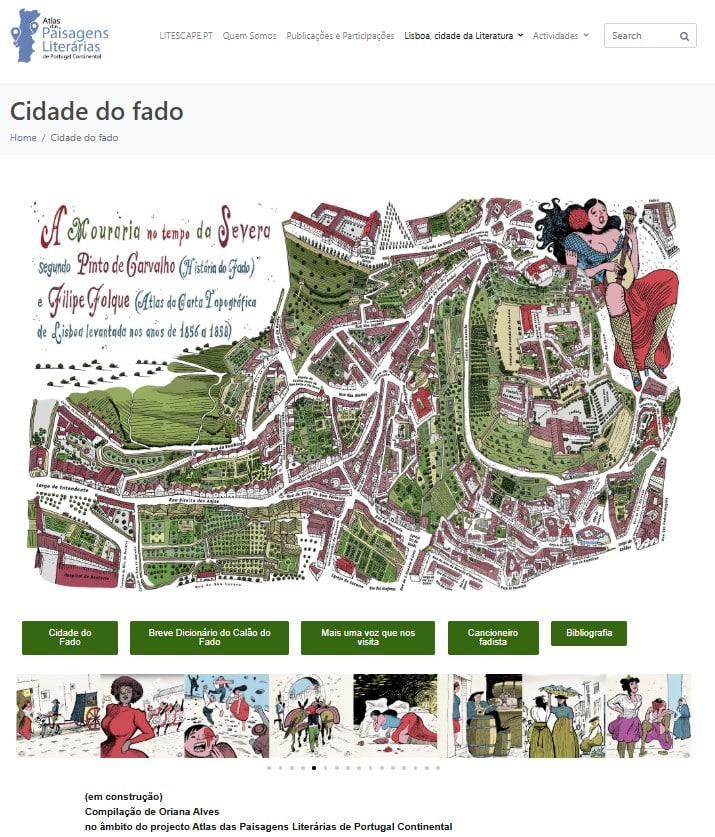
D.A./N.C.: The project website can be accessed on a computer, tablet or mobile phone. With GPS enabled, it is possible to view the literary extracts located within a 500-metre radius of your current location.
In the context of tourism, for instance, it is possible to take a self-guided walk in a city or in any other part of the country and see whether or not there are extracts associated with that place, then read them while looking at the landscape they describe. That ultimately becomes a very interesting feature as well. There are nearly 9.000 literary extracts currently recorded and grouped together on the website.

4. And with regard to literary hotels, does the Atlas include extracts and references connected to them?
D.A./N.C.: Our project was not originally conceived with the intention of studying literary hotels, or literary tourism. However, we were later invited to contribute to a project coordinated by Professor Sílvia Quinteiro of the Universidade do Algarve on the Literary Hotels in Mainland Portugal.
As for literary hotels in the Atlas, for example, we have references by Ramalho Ortigão and Eça de Queiroz to hotels in Sintra. In literature, there are wonderfully vivid descriptions of the atmosphere and landscape in which various hotels in Portugal are set, which also helps us to understand the relationship between society and landscape at that time.

Special thank you to Daniel Alves and Natália Constâncio, and to all participants in the event Conversations on Literary Tourism: Portugal: Literature and (is) Landscape (Lisboa Pessoa Hotel, Oct. 16, 2025).
Fabrizio Boscaglia
_
Discover Lisbon & Pessoa, starting at the Lisboa Pessoa Hotel, a boutique hotel themed around Fernando Pessoa.